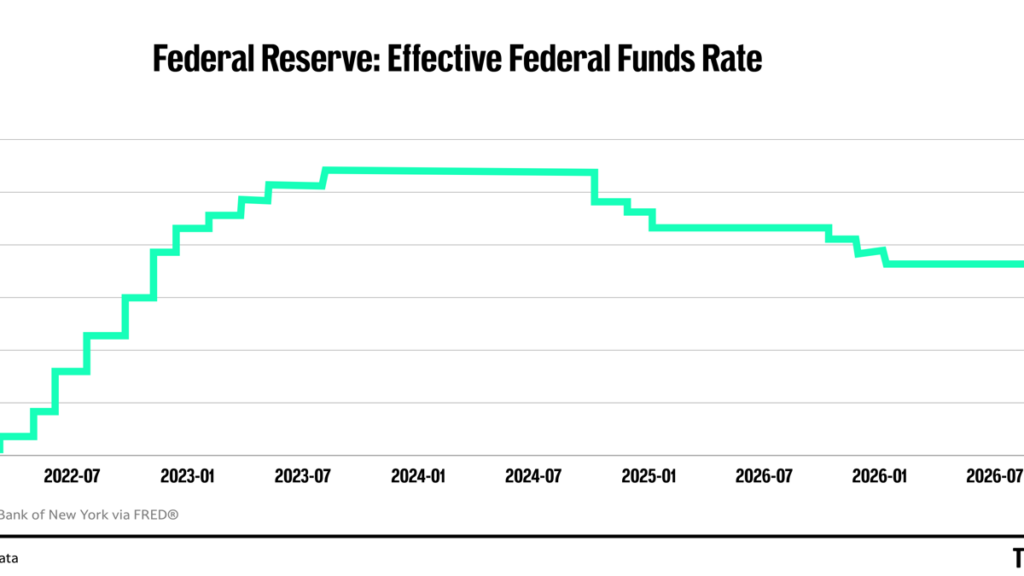
Six months into Federal Reserve Chairman Kevin Warsh’s promised “regime change” at the U.S. central bank, his policymaking colleagues find themselves navigating an unexpected post-midterm crossroads of affordability, artificial intelligence-driven economic shifts, and mounting monetary policy pressures.
It’s not only tricky but also delicate: Will the AI boom allow the expected December Fed rate hike to be “one and done?”
Coming just a week after American voters expressed notable hesitation regarding the rapid, resource-heavy AI buildout, Fed officials are sharply focused on how physical and digital capital expenditures can now intersect with broader price stability.
Among them are future 2027 Federal Open Market Committee voting members Richmond Fed President Thomas Barkin and Chicago Fed President Austan Goolsbee.
Both spoke Nov. 9 — on the eve of the October CPI data release — about the impact of AI on American households, businesses, and portfolios.
Fed officials warn of inflation impact from AI demand shifts
The question leading into the latest inflation figures: Will the widely-expected December Fed rate hike of 25 basis points to the target range of 4.0% to 4.25% be a “one and done deal?”
Barkin said in prepared remarks on Nov. 9 that the massive wave of AI infrastructure spending is actively adding to near-term inflation by driving robust demand.
“The path of AI feels particularly consequential. If it underdelivers, business investment could pull back, stock prices could follow, and so too could asset-fueled consumer spending,’’ Barkin said. “The risk runs the other way, too. AI could overdeliver and displace more workers than expected, resulting in a pullback in spending.”
Such overdelivery could rapidly displace workers and shift the Fed’s current mandate focus on price stability back to maximum employment.
Goolsbee, speaking at an event in Chicago Nov. 9, said the Fed officials must tackle potential overheating in the economy from the AI supply demand and the broadening of inflationary pressures across sectors.
“We’ve got to come to terms with this cost side and inflation side failure in the mandate,” Goolsbee said, as Bloomberg reported.
TheStreet
October CPI faces unusual data gap as Fed weighs next rate hike
There will be one major data point missing from the Nov. 10 October CPI report when it is released by the Bureau of Labor Statistics: the customary year-over-year comparisons. This is due to the data gaps caused by the 2025 government shutdown.
This will require economists and markets to rely more heavily on the monthly numbers.
Bloomberg economists project a median consensus that headline inflation will cool to +0.3% down from +0.6% in September, with core inflation, minus food and energy, ticking down to +0.2%.
Related: Democrats blue wave upends Trump’s Fed plan
However, even a softer inflation report may not deter policymakers from executing a tightening cycle when the Federal Open Market Committee meets Dec. 8-9. The robust October jobs report showed the economy added 165,000 jobs and unemployment dipped slightly to 4.1%, significantly beating consensus expectations.
The CME FedWatch Tool estimates an 83.4% probability of a 25-basis-point rate hike at the FOMC December meeting.
How many more Fed rate hikes are possible?
In a Nov. 9 note, UBS Wealth Management projected a continued, measured tightening cycle, starting with a 25-basis-point hike in December followed by another 25-basis-point hike in March 2027.
UBS economists said they do “not believe a measured tightening cycle will derail the U.S. economy or equity rally. Investors should maintain diversified equity exposure and use the rise in yields to add selectively to quality bonds, while remaining cautious on the longest maturities and lower-quality credit.’’
More Fed:
- Scott Bessent just reframed the case for a December rate hike
- Fed Chair Kevin Warsh reveals October surprise inside interest-rate pause
- How a Fed interest rate pause would impact Main Street investors
Mike Fratantoni, chief economist and senior vice president of research and business development at the Mortgage Bankers Association, forecast additional hikes in the tightening cycle into the first quarter of 2027.
“We think the Fed is going to be in a position where they have to hike a couple more times,” Fratantoni said Oct. 12.
Sticky inflation, energy shocks key to possible rate cuts
If sticky service costs and energy shocks from geopolitical conflicts remain uncomfortable above the Fed’s 2% target, Goolsbee and Barkin seem to be joining some of their fellow central bankers, insisting that they can’t afford to ignore demand and supply pressures in 2027.
If the underlying components of the October CPI report validate fears that inflation remains sticky beneath a cooler headline, watch for Fed watchers, investors, and consumers to shift away from optimism that interest-rate cuts are coming soon into the new year.
Hence a “one and done” scenario becomes increasingly unlikely if structural economic overheating keeps up.
In my opinion, this means Warsh and his esteemed colleagues could find themselves raising rates well into 2027, despite Warsh’s explicit commitment to price stability and lower inflation.
With this scenario, “one and done” may be wishful thinking rather than a credible Fed forecast.
Related: Fed Chair Kevin Warsh reveals October surprise inside interest-rate pause